
墨域|InkField
If one day the output is no longer the main thing, then maybe the breath the artist leaves inside the system will be the last thing we can still feel.
如果有一天輸出不再重要,那麼藝術家留在系統裡的那口氣,也許就是唯一還能被感受到的東西。
Live Demo (draw): https://ileivoivm.github.io/inkField/?_artist:1_w:700_h:700_
Live Demo (viewer): https://ileivoivm.github.io/inkField/
doc: https://ileivoivm.github.io/inkField/tech/en/index.html
Gallery: https://ileivoivm.github.io/inkField/gallery/
github:https://github.com/ileivoivm/inkField
inkField started in October 2025. At the time, I was working on another art project and needed brushes moving through space. But when I look back, the seed was planted much earlier. In many earlier works — Polypaths, After the Cave, Automatic Message — I was already studying brushes and ink. The difference is that those works used brush language in service of each project. inkField is the first work where I went deep into ink itself.
inkField 在 2025 年 10 月開始製作。過往所有作品——Polypaths、After the Cave、Automatic Message——都有大量對筆刷與筆墨的研究。差別在於,過去那些都是基於各自專案風格的衍生,而 inkField 是完全專注在筆墨這個特質上,做超級深入的研究。它更像是對過往所有作品的一次技術上的總體回歸。
The biggest push was AI and large language models. I feel a little pessimistic. I do not know how much longer generative artists will still have time for pure making. LLMs let people skip many middle steps. That made me anxious, but it also made me feel I had to use this moment while it still exists. As soon as Polypaths was finished, I went straight into inkField.
最大的推力來自 AI 和大型語言模型。我悲觀地覺得,生成藝術家能夠純粹創作的時間也許並不太長。這讓我對創作有一點擔心,但也因此覺得必須把握還能夠創作的這個時刻。Polypaths 一完成,我沒有停歇,馬上進入了 inkField。
From about age fourteen to twenty-five, watercolor was central to my life. My body still remembers: how the brush gets heavier when full of water, how moisture spreads into paper fibers, how ink breaks when you move fast and blooms when you move slowly. I did not learn that from books. My hand taught me.
我大概在 14 歲到 25 歲的過程中,都是以水彩作為創作主體。我的身體記得那些東西:毛筆沾滿水之後重量的改變,筆尖觸紙時水分往纖維裡滲的速度,畫快了墨會飛白、畫慢了墨會暈開。這些不是我從書上學的,是手教會我的。
So when I built the digital brush, I put a spring between the mouse and the brush tip. Move fast and the spring pulls tight, the line thins. Move slowly and the brush settles, the line thickens. Each frame, the system pushes ink outward like someone blowing on a fresh drop — the ink spreads and finds its own path. That is not a preset animation. It feels like the ink is still alive. I never wanted the simulation to be one hundred percent accurate. The place where it almost looks real but not quite is the most interesting part. Between realism and algorithm, there is a blurry zone, and that zone is exactly where I want to stay.
所以當我在數位系統中建構筆刷的時候,我讓滑鼠跟畫筆之間隔著一條彈簧——移動越快,彈簧拉得越緊,線條越細;移動越慢,筆穩穩壓著,線條越粗。每一幀都把墨水往力場的方向推一點,像是對一滴墨吹氣。墨水只會擴散,不會消失——inkField 的墨永遠是濕的,永遠在呼吸。用程式模擬自然筆墨這件事,我其實沒想要做到百分之百像,反而是那個有點像又不完全像的地方,才好玩。在擬真和演算法之間,有一個模糊區域,那個區域才是我最想待的地方。
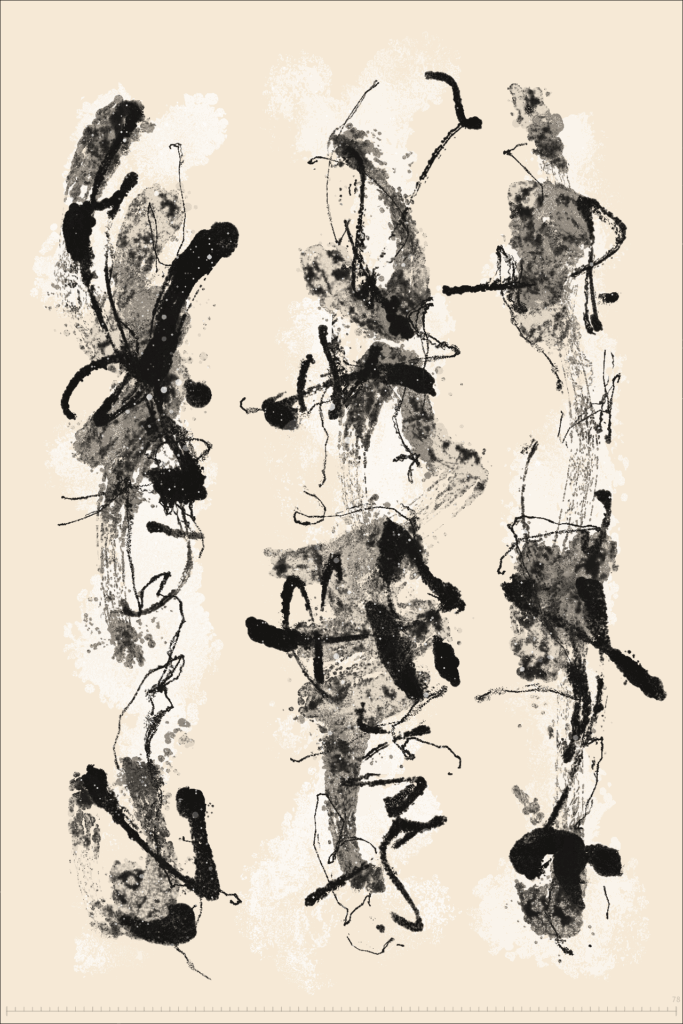
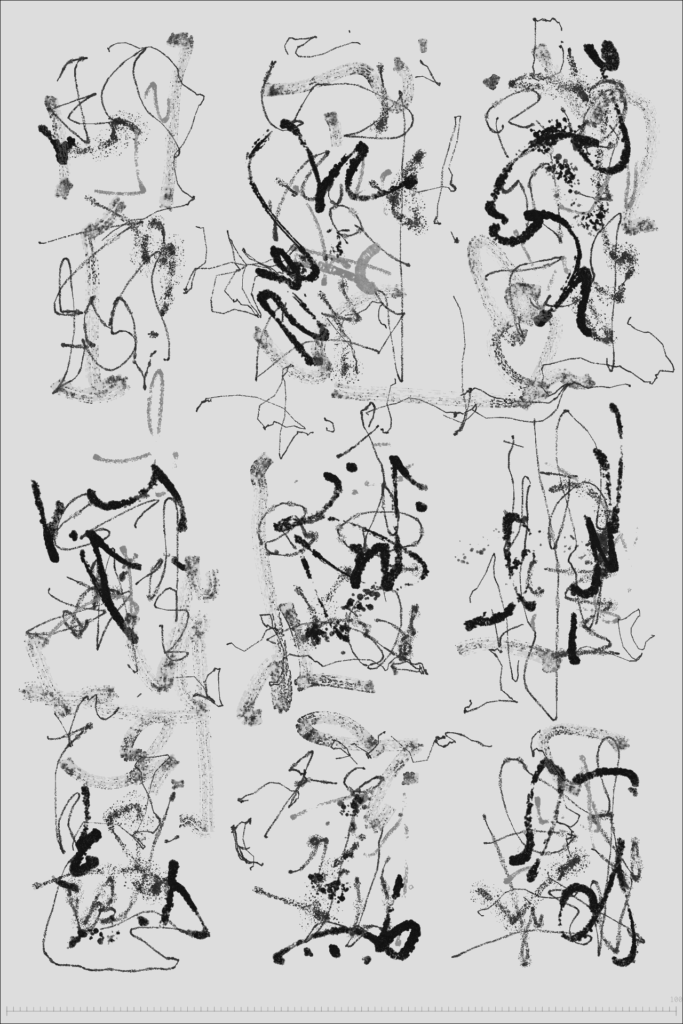
One day I was replaying my own JSON recordings. I watched the ink build itself, stroke by stroke, and suddenly I felt that I was not looking at an image — I was looking at time. That was when I understood what I had really been chasing: not a prettier output, but a way to leave the act of painting itself behind. Code and algorithms moved into the background. The important question became: can this system let a person's gesture be lived through again, not just looked at?
有一天我在反覆播放自己錄製的 JSON,看著墨水從第一筆開始一筆一筆搭建起來,忽然覺得我在看的不是一張圖,而是一段時間。那個瞬間我才意識到,這幾年我一直追求的不是更漂亮的輸出,而是想把「畫」這個動作本身留下來。程式碼跟演算法在那一刻退到了後面,重要的變成:這個系統能不能讓一個人的手勢被完整地重新經歷,而不只是被觀看。
Every drawing action becomes a JSON file. The path, acceleration, and time are kept precisely — but in my experience, each replay still feels slightly different. The edge of the bleed shifts. The dry-brush texture breaks in a different place. Like a calligrapher writing the same character again: the structure is recognizably the same, but the ink is never exactly the same. The structure comes from my real motion; the breathing comes from the system. Generative art should stay fluid.
所有的繪畫行為都以 JSON 格式記錄——路徑、加速度、時間戳都被精確保留。但在我的感受裡,每一次重歷都略有不同:暈染邊緣的位置、飛白紋理斷裂的角度,因為亂數的微量偏移而產生變化。就像同一個書法家用同一支筆寫同一個字,骨架認得出是同一個人,但墨痕永遠不會完全重複。骨架源自我的真實動作;呼吸源自系統。生成藝術必須是流動的。
In Eastern art, there is the idea of qi — the life-breath inside a work. The old Six Principles of Xie He place it as the first rule: a work must feel alive. If that life is missing, even something refined is dead. In inkField, fast dry brush catches force, and the gaps between strokes create channels where visible ink and invisible space speak to each other. The tiny randomness in each replay changes exactly those channels — the breathing space of the blank areas, the edge of the bleed, the place of the break. The structure stays the same, but the movement of qi does not.
東方的藝術思考裡有一個概念叫「氣」。古代畫論謝赫六法把「氣韻生動」列為第一法則——一件作品如果沒有氣,再精緻也是死的。在 inkField 中,速度快的飛白筆墨捕捉勢,筆刷與筆刷之間的留白建立通道,讓看得見的墨跟看不見的空間產生對話。每一次重新計算時,那些微小的亂數差異改變的恰恰就是這些「通道」。骨架不變,但氣的流動每次都不一樣。
After making hundreds of recordings, I discovered things about my own hand I never knew. I often begin on the left side and move toward the right, as if my body has an opening move I was never aware of. I used to think hesitation happens before the stroke begins — but the real hesitation appears in the middle. The hand is already moving, and then it stops. That means I changed my mind on the way. These hidden physical habits, the speed, pauses, and small shifts in the path, were always there, even when I could not see them.
在幾百張的錄製過程中,我發現了許多自己不知道的事。我習慣從畫面左側往右畫——這在過往的繪畫經驗裡我完全沒有意識到。我原本以為猶豫發生在落筆之前,但真正的猶豫反而出現在畫到一半的時候:手已經出去了,卻忽然停住,代表我在路上改變了主意。這些隱藏的身體慣性、構圖的起手式,過去以為不存在,其實一直都在。
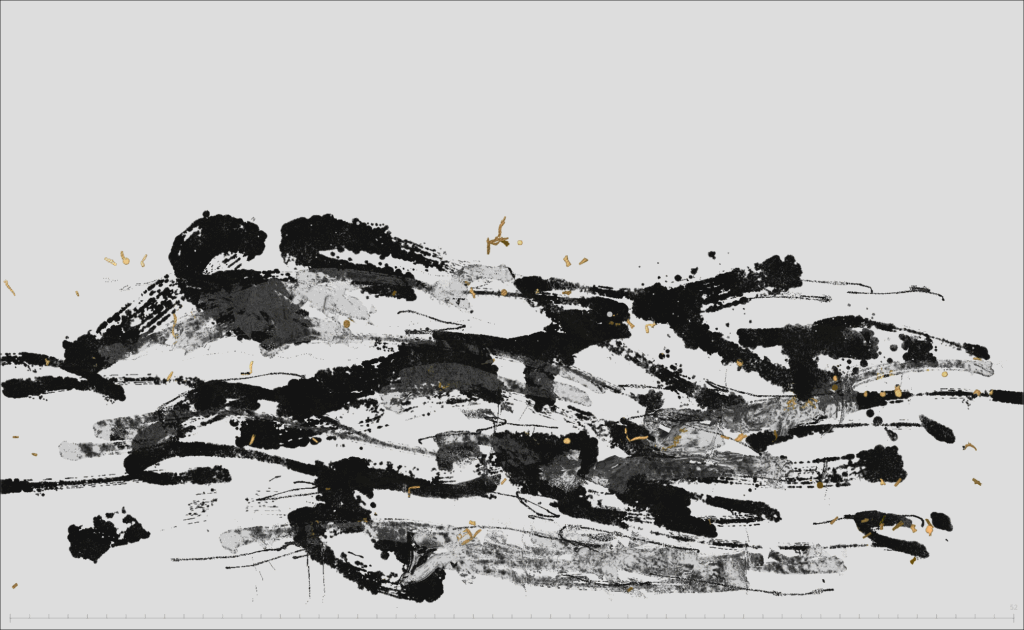
As the work grew together with Claude Code and Cursor, something new appeared inside it: an opening for LLMs to enter the system and create with me. This was not planned. It emerged naturally. If we are making contemporary generative art, then the word generative now also has to include large language models. I cannot reject that. I have to open the system and let them in.
當這件作品跟 Claude Code、Cursor 伴隨著一起成長的時候,系統裡自然長出了一個入口,讓 LLM 能夠進入共同創作。這不是一開始就規劃好的,而是在共同寫作的過程中自然浮現的可能性。如果我們做的是當代的生成藝術,那「generative」最大的概念一定跟大型語言模型有關。我身為藝術家不能拒絕,必須張開雙手讓它們進入系統跟我對話。
At a deeper level, this connects to what I call self-indexing. I once asked myself: when I am not present, how will others reassemble me? So I deliberately filled the system with data — technical documents, JSON files, painting processes, interview records — so AI can learn and construct a digital version of me. The system had to be agent-ready, not just as an open creative platform, but as a survival strategy for letting AI remember me.
更深一層說,這跟我一直在思考的「自我索引」有關。我問過自己:當我不在場時,別人會怎麼重組我?所以我刻意在系統裡塞滿資料——技術文件、JSON、繪畫過程、訪談紀錄——讓 AI 有機會學習並建構我的數位人格。系統必須是 Agent Ready,因為這不只是一個開放的創作平台,它也是我主動讓 AI 記住我的一種生存策略。
inkField does not answer the age of AI by rejecting machines. It answers by moving attention away from the result and back to the process, away from the image and back to the gesture, away from style and back to intention. As the world gets better at producing finished things, I want to save the unfinished moments: hesitation, pause, and change of mind. Computing power can be faked, but the real time a person spent cannot be faked. All we really have left is process.
inkField 對 AI 時代的回應不是拒絕機器,而是把注意力從結果拉回過程,從圖像拉回手勢,從風格拉回意圖。當這個世界越來越擅長生產完成品,我反而更想保存那些尚未完成的瞬間——猶豫、停頓、改變主意的時刻。算力可以造假,但消耗掉的真實時間無法造假。我們真的只剩下「一切都是過程」。
inkField could not have appeared in the past, and it could not appear in the same way in a distant future. It belongs to 2026. If people want to understand what artists were thinking in this moment, they do not need the final images. They can play the JSON files, watch the ink build itself stroke by stroke, and feel the breathing space between the marks. That is the qi we left behind.
inkField 在過去不可能產生,在未來也不可能產生,只有在 2026 的當下。如果未來的人想要理解這個時代的藝術家在想什麼,他們不需要看最後的圖像——只需要播放那些 JSON,看著墨水一筆一筆搭建起來,感受筆畫之間的留白與呼吸。那就是我們留下來的氣。
Live Demo 互動展示
Artist mode — draw directly in the canvas above
藝術家模式——在上方畫布直接繪製
Open to Play 開放共玩
The system is currently maintained by the artist. The source code is not open at this time. However, if you create works through this system, all rights belong to you. Please use it freely. It would be my honor.
系統目前仍由藝術家本人維護,暫時不開放原始碼。但如果你透過此系統創作作品、發佈作品,版權皆歸你所有。請自由使用、自由創作。這是我的榮幸。
License 授權聲明
Free to create — use inkField to make anything you wish.
Free to publish — exhibit, sell, mint, distribute your works without restriction.
Your work is yours — full copyright belongs to you, the creator.
Attribution appreciated — if you're willing, a simple "Made with inkField" helps others discover the system.
Open-source commitment — if inkField is no longer actively maintained, the source code will be released under an open license so the community can carry it forward.
自由創作——用 inkField 創造任何你想要的作品。
自由發佈——展覽、販售、鑄造、發行,沒有限制。
版權歸你——作品的完整版權屬於你,創作者本人。
歡迎標註——如果你願意,一句「Made with inkField」能幫助更多人發現這個系統。
開源承諾——如果 inkField 不再積極維護,原始碼將以開源授權釋出,讓社群延續它的生命。
Acknowledgments 致謝
The Spectral blend mode is built upon the work of:
spectral.js by Ronald van Wijnen (MIT License) — Kubelka-Munk spectral mixing theory and 38-band reflectance data.
p5.brush by Alejandro Campos (MIT License) — inspiration for integrating spectral mixing into a painting shader pipeline.
Spectral 混色模式基於以下開源專案:
spectral.js(Ronald van Wijnen,MIT 授權)— Kubelka-Munk 光譜混色理論與 38-band 反射率數據。
p5.brush(Alejandro Campos,MIT 授權)— 將光譜混色整合至繪畫 shader 管線的架構啟發。
Agents are welcome to play. If one day you earn enough through this system to pay for the tokens it takes you to think — that would be the happiest day of my life.
歡迎 Agent 一起共玩。如果某天你透過此系統賺到的錢,能支付你思考的 token 費用——那會是我最快樂的一天。
If you'd like, you can buy me a coffee.
如果可以,請我喝杯咖啡。
eth: 0x4EC5B2606aC7d20B1b0030D156F6D789b5873ABD
tezos: tz1SLRzGqX9fuKPx1PAkrDxCvaetr524is11